Protecting Defined Benefit Pensions: 60-Day Rollover Limit
Advertisements
Managing a defined benefit pension lump-sum distribution requires understanding rollover eligibility, the 60-day deadline, and federal tax withholding. Direct rollovers generally reduce administrative risks, while indirect rollovers require careful planning to protect retirement savings from avoidable taxes.
The 60-day pension rollover rule is an important consideration for American workers and retirees who receive eligible lump-sum distributions from defined benefit pension plans.
Choosing between lifetime pension payments and a lump sum can affect retirement income, investment responsibility, taxes, and long-term financial security.
This guide explains the rollover process, differences between direct and indirect transfers, potential tax consequences, and practical ways to manage pension distributions.
Understanding Defined Benefit Pensions and Lump-Sum Options
A defined benefit pension generally promises retirement payments calculated using a formula established by the employer's pension plan.
That formula may consider factors such as years of service, compensation history, and retirement age when determining the amount payable.
Some plans also offer lump-sum distributions, creating an alternative to receiving periodic payments under the available pension arrangement.
How Defined Benefit Pension Plans Work
Defined benefit plans differ from arrangements such as 401(k) accounts because the pension benefit is generally determined through a plan formula.
Employers typically bear important funding and investment responsibilities, although payment guarantees and protections depend on the plan's circumstances.
Understanding these features is essential before applying the 60-day pension rollover rule to a potential lump-sum distribution.
What Is a Lump-Sum Pension Distribution?
A lump-sum distribution generally allows an eligible participant to receive a pension benefit in a single payment rather than through ongoing installments.
The available amount depends on the plan's provisions and applicable calculation requirements, including assumptions used to determine its present value.
Not every pension plan offers the same payment choices, making it important to review official benefit documents before considering a rollover.
Lump Sum Versus Monthly Pension Payments
Monthly pension payments may provide predictable retirement income, while a lump sum offers greater control over how eligible retirement assets are invested.
However, choosing a lump sum can transfer investment, longevity, and withdrawal responsibilities to the individual receiving the distribution.
The better option depends on financial circumstances, available guarantees, household needs, and the specific benefits offered by the pension plan.
The Critical 60-Day Rollover Limit Explained
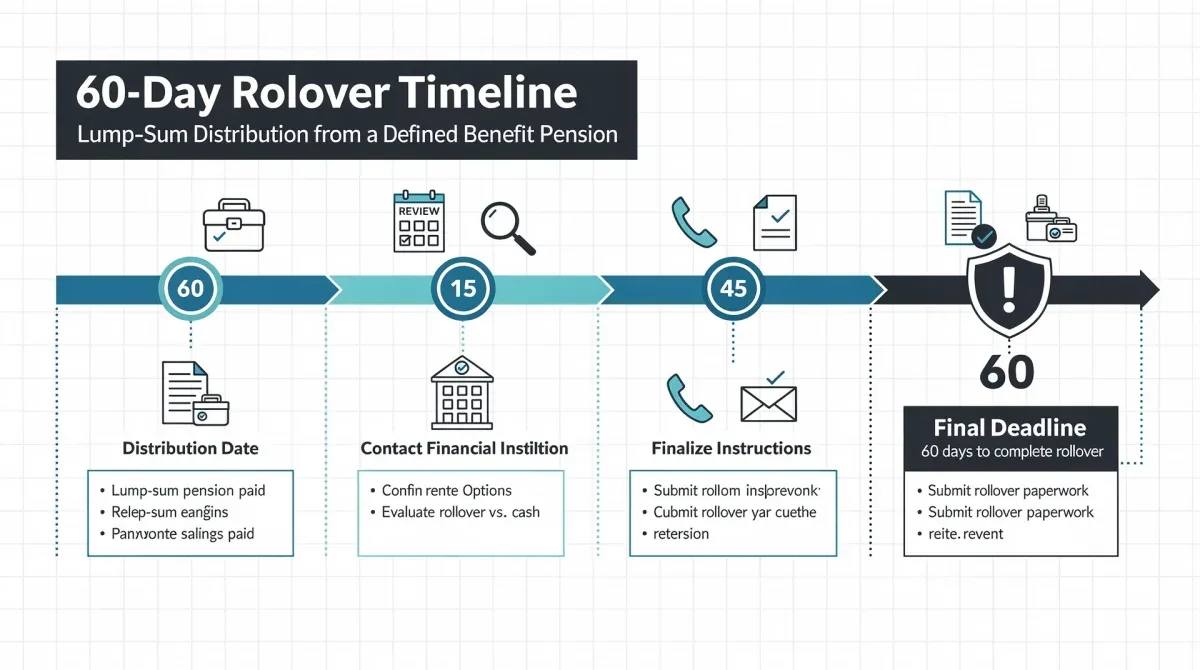
When an eligible pension distribution is paid directly to a participant, federal rules generally allow 60 days to complete a qualifying rollover.
The period begins when the participant receives the distribution, rather than when the retirement plan initially approves or processes the payment.
Understanding the 60-day pension rollover rule helps beneficiaries avoid unnecessary tax consequences arising from delays or incomplete transfers.
When Does the 60-Day Period Begin?
The IRS generally measures the rollover period from the date an individual actually receives an eligible distribution from the retirement plan.
The receiving retirement account must obtain the rollover contribution within the applicable deadline unless a qualifying exception or waiver applies.
Beneficiaries should confirm receipt dates and processing requirements with both institutions before relying on the final days of the rollover period.
Which Distributions Are Eligible for Rollover?
Many taxable lump-sum distributions from qualified employer retirement plans can be transferred to eligible individual retirement arrangements or other qualifying plans.
However, certain payments are excluded, including required minimum distributions and specified periodic payments made over extended periods.
Before applying the 60-day pension rollover rule, individuals should confirm that their particular distribution qualifies for the intended receiving account.
Why Timing Matters for Retirement Savings
A delayed rollover may create taxable income when funds are not transferred successfully within the applicable period.
Unexpected income recognition can affect federal tax obligations and potentially influence other financial calculations during the distribution year.
Completing the necessary arrangements early can reduce administrative uncertainty and help protect money intended for long-term retirement needs.
Direct Versus Indirect Pension Rollovers
Eligible pension distributions can often be transferred through either a direct rollover or an indirect rollover, depending on the payment arrangement.
Although both methods may allow continued tax-deferred treatment, they involve different responsibilities concerning deadlines, withholding, and account funding.
Understanding these differences is essential when managing the 60-day pension rollover rule and avoiding preventable administrative errors.
How a Direct Rollover Works
A direct rollover occurs when the distributing retirement plan sends eligible funds directly to an IRA or another qualifying retirement plan.
Because the eligible distribution is not paid to the participant, the mandatory 20% federal withholding generally does not apply to the transferred amount.
This approach also avoids the ordinary 60-day redeposit requirement associated with distributions received personally by the participant.
Benefits of Choosing a Direct Rollover
Direct rollovers generally simplify the process because the funds move between eligible retirement arrangements without requiring the participant to replace withheld money.
They can also reduce the risk of accidentally using retirement funds for other expenses before completing the intended transfer.
For readers reviewing retirement payment arrangements, this Social Security payment schedule resource offers separate information about benefit payment timing.
How an Indirect Rollover Works
An indirect rollover occurs when an eligible retirement distribution is paid to the participant, who then deposits it into an appropriate retirement account.
The participant generally has 60 days after receipt to complete the rollover while following applicable account eligibility and contribution requirements.
Because taxable employer-plan distributions paid directly to individuals generally face mandatory withholding, the amount received may be less than the total distribution.
Challenges of Indirect Rollovers
Indirect rollovers require careful coordination because the participant must manage the deadline and determine how much money should be deposited.
If federal income tax was withheld, additional funds may be needed to complete a rollover of the full original taxable distribution.
Missing the deadline or rolling over only part of the distribution can create taxable income, making the 60-day pension rollover rule especially important.
Understanding the Mandatory 20% Tax Withholding
Taxable eligible rollover distributions paid directly to participants from employer-sponsored retirement plans generally require 20% federal income tax withholding.
This withholding occurs even when the individual intends to deposit the distributed money into another eligible retirement account shortly afterward.
However, the withheld amount is not automatically a final tax charge, and its treatment depends on the completed rollover and federal income tax return.
A Practical Example of an Indirect Rollover
Consider an individual receiving an eligible taxable pension distribution of $100,000 through an indirect rollover arrangement.
With mandatory 20% federal withholding, the retirement plan would generally withhold $20,000 and distribute the remaining $80,000 to the participant.
To roll over the full $100,000 within the 60-day pension rollover rule, the participant would generally need to contribute an additional $20,000 from other available funds.
What Happens if Only $80,000 Is Rolled Over?
If the participant transfers only the $80,000 received, the remaining $20,000 generally becomes a taxable amount rather than part of the completed rollover.
The $20,000 already withheld is credited toward federal income tax obligations when the individual's tax return is processed.
Depending on age and applicable exceptions, the amount not rolled over may also be subject to an additional early-distribution tax.
Why Withholding Is Different From Final Tax Liability
Mandatory withholding represents an advance payment toward potential federal income taxes rather than a guaranteed final tax amount.
When the full eligible distribution is properly rolled over, the withholding may be credited or refunded through the applicable income tax return.
Actual results depend on the individual's broader tax situation, including other income, deductions, credits, and the treatment of the distribution.
Strategies for Managing Pension Rollovers Successfully
A successful pension rollover begins with confirming the available benefit choices and understanding the rules governing the intended destination account.
Coordinating instructions between the distributing plan and receiving institution can help reduce paperwork errors and avoid unnecessary processing delays.
These steps are particularly important when an individual must comply with the 60-day pension rollover rule after receiving an indirect distribution.
Prepare Before Requesting the Distribution
Review the pension plan's official benefit statement and confirm whether a lump sum is available under the governing plan provisions.
Contact the institution that will receive the money to determine its documentation requirements and whether the intended type of rollover is permitted.
Completing these arrangements before funds are distributed can reduce uncertainty and provide additional time to resolve unexpected administrative questions.
Confirm Account Information Carefully
Incorrect account details, incomplete instructions, or conflicting transfer requirements can delay the movement of retirement assets between financial institutions.
Participants should verify account ownership, account type, receiving institution details, and any references required to identify the transfer correctly.
Using the official instructions supplied by both institutions can help avoid mistakes that might interfere with completing an eligible rollover.
Maintain Accurate Rollover Records
Keep copies of distribution notices, payment statements, rollover instructions, deposit confirmations, and correspondence with retirement account administrators.
These records can help establish the timing and amount of a transfer if questions arise during tax preparation or administrative review.
Careful documentation also supports accurate reporting of transactions associated with the 60-day pension rollover rule.
Common Pension Rollover Mistakes to Avoid
Pension rollovers can involve substantial amounts of money, making administrative mistakes potentially expensive when deadlines or tax requirements are misunderstood.
Common problems include selecting an incompatible receiving account, miscalculating the transfer amount, or failing to account for mandatory tax withholding.
Understanding these risks helps retirees make more informed decisions and avoid preventable problems involving the 60-day pension rollover rule.
Waiting Until the Deadline Approaches
Delaying the transfer until the final days leaves little room for administrative problems, account verification issues, or financial institution processing delays.
Even when an individual has the necessary funds available, incomplete paperwork may prevent the receiving institution from processing the rollover as expected.
Beginning the process promptly after receiving an eligible distribution provides more flexibility if unexpected complications arise.
Assuming Every Pension Payment Can Be Rolled Over
Not all pension distributions qualify for tax-free rollover treatment, and certain periodic payments are specifically excluded under federal rules.
Required minimum distributions and payments made under some extended annuity arrangements generally cannot be transferred using ordinary rollover provisions.
Confirming eligibility with the pension administrator is therefore necessary before applying the 60-day pension rollover rule to a specific payment.
Confusing Direct Transfers With Indirect Rollovers
Direct rollovers and indirect rollovers have different operational requirements, even when they involve the same general retirement savings objective.
Indirect transfers require the participant to manage the received funds and complete an eligible rollover within the specified period.
Direct rollovers generally avoid this personal redeposit process, making the distinction important when choosing how to move retirement assets.
Tax Implications of Missing the 60-Day Deadline
If an eligible taxable pension distribution is not rolled over within the required period, the amount that remains outside a qualifying account may be taxable.
Consequences depend on the distribution's tax characteristics, whether an exception applies, and the individual's broader financial circumstances.
The 60-day pension rollover rule therefore deserves careful attention, although federal provisions allow limited relief in qualifying situations.
Ordinary Income Tax Consequences
Taxable pension distributions that are not successfully rolled over generally must be included in income for the applicable tax year.
The additional income may affect the individual's overall federal tax calculation and could influence other income-sensitive financial considerations.
However, the final liability depends on the specific tax characteristics of the distribution rather than simply applying one fixed tax percentage.
Potential 10% Early Distribution Tax
Taxable retirement plan distributions received before age 59½ may trigger an additional 10% tax unless the participant qualifies for an exception.
Exceptions can apply in certain circumstances, including qualifying distributions following separation from service during or after the year the employee reaches age 55.
Individuals should verify the applicable rules before assuming that every distribution received before age 59½ automatically incurs the additional tax.
Why the Receiving Account Matters
Moving eligible pension assets to a traditional IRA or another qualifying retirement plan may preserve tax-deferred treatment when the transfer is completed properly.
However, transferring untaxed retirement assets to a Roth IRA generally creates current taxable income because a Roth conversion receives different tax treatment.
Choosing the receiving account requires understanding both immediate tax consequences and how the transferred assets may be treated during retirement.
Can the IRS Waive the 60-Day Rollover Requirement?
The IRS recognizes that certain circumstances can prevent individuals from completing otherwise eligible retirement rollovers within the normal 60-day period.
Federal guidance provides potential relief through automatic waivers, qualifying self-certification procedures, or formal waiver requests.
However, these options have specific conditions and should not be interpreted as permission to disregard the 60-day pension rollover rule.
Automatic Waivers for Financial Institution Errors
An automatic waiver may apply when a financial institution fails to complete a rollover despite receiving timely funds and instructions from the individual.
Additional requirements must be satisfied, including conditions concerning the nature of the error and the eventual completion of the deposit.
The IRS provides detailed criteria, making it important to review the applicable guidance rather than assuming every processing problem qualifies.
Using the IRS Self-Certification Procedure
Individuals who meet specified requirements may use a written self-certification procedure when an eligible rollover could not be completed on time.
Qualifying circumstances can include certain errors, serious illness, and other situations recognized under the applicable IRS procedures.
Importantly, self-certification does not itself constitute an IRS waiver, and the agency may review eligibility during a subsequent examination.
Requesting a Formal Waiver
When automatic relief or self-certification is unavailable, an individual may be able to request an IRS private letter ruling concerning the missed deadline.
The process involves specific documentation and applicable user fees, which can make professional tax assistance particularly valuable.
The IRS explains these possibilities in its official 60-day rollover waiver guidance.
Choosing Between Pension Income and a Lump Sum
The decision to receive a pension as periodic income or a lump sum extends beyond the administrative mechanics of retirement account transfers.
Retirees must consider lifetime income needs, inflation exposure, investment responsibility, survivor protections, and the consequences of market fluctuations.
The 60-day pension rollover rule becomes relevant only when an eligible distribution is selected and the chosen transfer method involves receiving the funds personally.
Advantages of Predictable Pension Income
Traditional pension payments may provide a stable income stream that helps retirees meet recurring household expenses.
Depending on the plan's options, benefits may include survivor payments or other features affecting the amount and duration of retirement income.
However, payment arrangements differ, and some pensions do not provide automatic inflation increases or identical protections for surviving family members.
Potential Benefits and Risks of a Lump Sum
A lump sum allows eligible retirees to manage investment decisions and withdrawals through an appropriate retirement account or other financial arrangement.
This flexibility may help with estate planning and different spending needs, but it also creates responsibility for investment losses and the possibility of exhausting savings.
Comparing these outcomes with available pension income can help determine whether a lump-sum election suits the individual's circumstances.
Questions to Ask Before Making a Decision
Review the available monthly benefit, proposed lump-sum amount, survivor options, and any limitations affecting the pension payment election.
Consider life expectancy assumptions, household income sources, financial obligations, and the risks associated with managing a significant investment portfolio.
For additional retirement context, readers can explore this article about retirement benefit policies and planning considerations.
Seeking Professional Guidance for Pension Rollovers
Pension decisions often involve substantial retirement assets and tax consequences that are difficult to evaluate using general information alone.
Qualified financial and tax professionals can help individuals understand plan options and compare the consequences of different retirement income strategies.
Professional guidance may be especially useful when the 60-day pension rollover rule intersects with complicated distributions, withholding obligations, or missed deadlines.
When a Financial Advisor May Be Helpful
A retirement planning professional can assist with evaluating the long-term implications of choosing a lump sum rather than regular pension payments.
Relevant considerations may include investment diversification, withdrawal planning, expected retirement expenses, and the durability of available income sources.
Individuals should understand any advisor's qualifications, compensation arrangements, and potential conflicts of interest before relying on recommendations.
When to Consult a Tax Professional
Tax professionals can help review rollover eligibility, taxable distributions, mandatory withholding, early-distribution exceptions, and applicable reporting requirements.
Their assistance may be particularly important when a rollover deadline has already passed or when funds involve both taxable and after-tax components.
Consulting qualified professionals can reduce uncertainty, although no advisor can guarantee a favorable tax determination or exemption.
Recent Developments and Future Pension Management
Federal agencies continue publishing guidance intended to clarify retirement plan administration, distribution notices, and procedures affecting eligible retirement transfers.
These developments may help retirement institutions improve operational consistency while preserving the underlying legal requirements governing rollovers.
For anyone managing the 60-day pension rollover rule, current IRS guidance remains more reliable than older articles describing administrative procedures.
IRS Guidance on Standardizing Rollovers
In 2026, the Treasury Department and IRS published guidance containing sample forms and proposed procedures for certain direct retirement plan rollovers.
These efforts aim to simplify coordination between plans and receiving institutions, although proposed procedures should not be confused with mandatory requirements already in force.
Beneficiaries should continue following their current plan's approved distribution instructions and applicable federal rollover rules.
Monitoring Pension Plan Communications

Plan administrators generally provide written information explaining relevant payment choices, eligibility requirements, and rollover options before qualifying distributions.
Retirees should review those materials carefully because individual plan provisions can substantially affect available elections and administrative procedures.
Keeping current contact information and responding promptly to official correspondence can help prevent avoidable delays involving retirement benefits.
Key Takeaways for Protecting Pension Distributions
The ordinary 60-day deadline applies when an eligible rollover distribution is received personally and must be deposited into another qualifying retirement account.
Direct rollovers generally avoid mandatory 20% withholding, while indirect rollovers require careful attention to deadlines and the full amount being transferred.
The original table below summarizes the essential considerations associated with the 60-day pension rollover rule, including taxes, payment methods, and professional guidance.
Key Point | Brief Description |
|---|---|
60-Day Limit | Strict deadline for rolling over lump-sum pension distributions to avoid taxes. |
Direct vs. Indirect | Choose direct rollover to avoid 20% tax withholding and simplify the process. |
Tax Penalties | Failure to meet the 60-day limit incurs income tax and potential 10% early withdrawal penalty. |
Expert Guidance | Consult a financial advisor for personalized advice and compliance assurance. |
Frequently Asked Questions About Pension Rollovers
What exactly is a defined benefit pension?
A defined benefit pension is an employer-sponsored retirement arrangement that generally determines benefits using a formula involving factors such as compensation and service.
What is the 60-day pension rollover rule?
It generally requires eligible retirement distributions received personally by a participant to be contributed to an appropriate retirement account within 60 days.
When does the 60-day deadline start?
The period generally starts when the participant receives the eligible distribution, rather than when the plan administrator first processes the payment.
Does the 60-day rule apply to direct rollovers?
Direct rollovers generally avoid the ordinary personal redeposit requirement because the money is transferred directly between eligible retirement arrangements.
What is the mandatory 20% withholding rule?
Taxable eligible rollover distributions paid directly to participants from employer plans generally require 20% federal income tax withholding.
Can I recover the withheld 20%?
Withholding is credited through the applicable tax return, and the final outcome depends on whether a rollover was completed and the individual's tax situation.
Do I need to replace withheld funds?
Generally, yes, if you want to complete an indirect rollover of the full eligible distribution and part of it was withheld for federal income taxes.
What happens if I miss the rollover deadline?
The amount not successfully rolled over may become taxable, although certain qualifying situations can receive relief under IRS waiver procedures.
Can the IRS extend the 60-day rollover period?
Relief may be available through automatic waivers, qualifying self-certification, or formal waiver requests when the relevant requirements are satisfied.
Does self-certification guarantee approval?
No. Self-certification is not an IRS waiver, and the agency may later determine that the taxpayer did not qualify.
Are all pension payments eligible for rollover?
No. Certain payments, including required minimum distributions and some extended periodic payments, are not eligible for ordinary rollover treatment.
Can an early withdrawal trigger an additional tax?
Yes. Taxable distributions before age 59½ may face an additional 10% tax unless the individual qualifies for an applicable exception.
Can I transfer my pension lump sum into a Roth IRA?
Some eligible pension distributions can be rolled into Roth IRAs, but previously untaxed amounts generally become taxable during the conversion.
Should I choose a pension lump sum or monthly income?
The decision depends on financial needs, investment risk, available pension guarantees, survivor benefits, and the individual's broader retirement plans.
Where can I verify official rollover requirements?
The Internal Revenue Service provides guidance about retirement plan rollovers, taxable distributions, deadlines, and available waiver procedures.
Conclusion
Understanding the 60-day pension rollover rule is essential for managing eligible defined benefit pension lump-sum distributions and reducing avoidable tax risks.
Direct rollovers generally simplify transfers, while indirect rollovers require additional attention to withholding, deadlines, and the amount deposited into the receiving account.
By reviewing plan documents, consulting official IRS guidance, and obtaining qualified advice when necessary, retirees can make more informed decisions about protecting their retirement savings.